
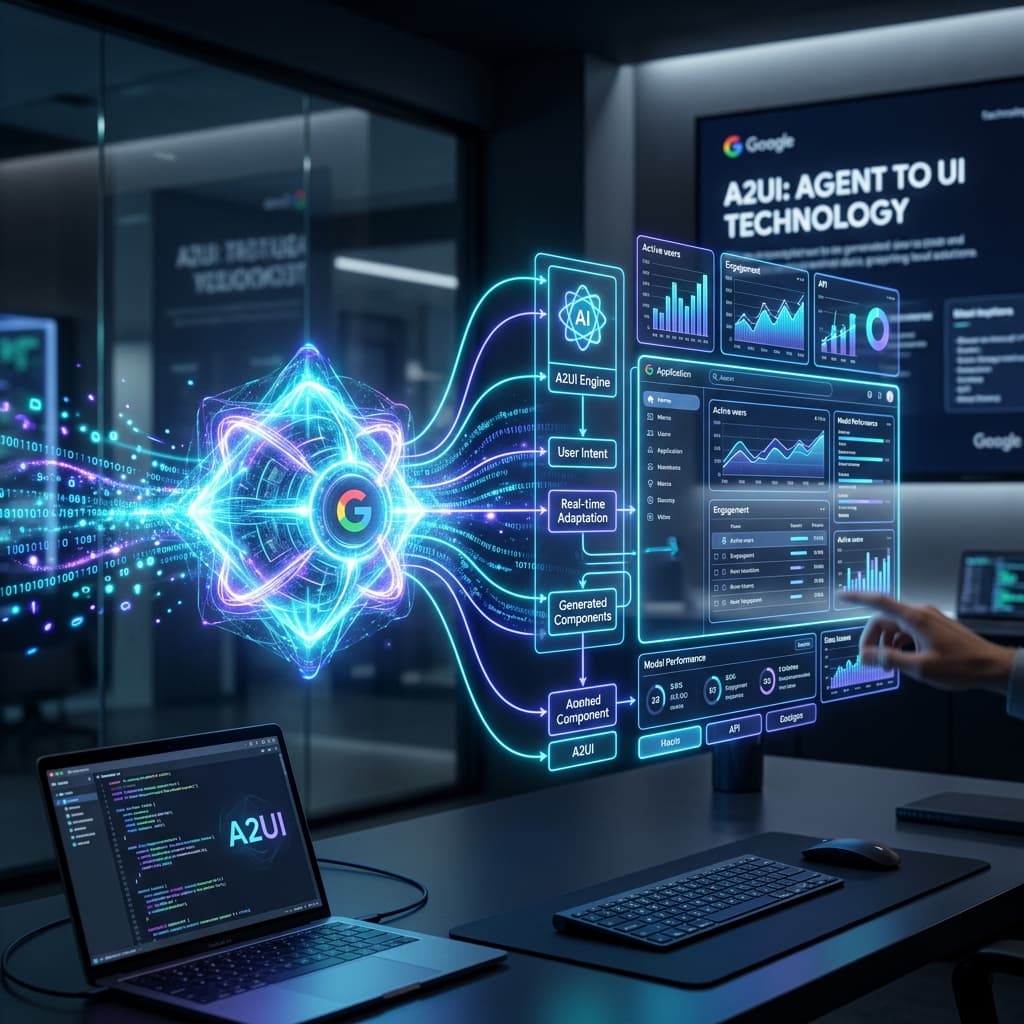
The Dawn of Dynamic Generation
If you have been building software for the past decade, you have watched the frontend ecosystem evolve at a breakneck pace. We started by wrestling with static HTML layouts, painstakingly moving <div> elements pixel by pixel via CSS floats. We eventually moved to reactive, component-driven architectures like React, Vue, and Svelte.
But today, we stand on the precipice of something entirely different—something that fundamentally alters the relationship between the developer, the interface, and the end-user.
Welcome to the era of Agent-to-UI (A2UI).
Spearheaded by the latest innovations from Google and adjacent research in multimodal Large Language Models (LLMs), A2UI isn't just another JavaScript framework. It’s an entirely new paradigm for how humans interact with machines. Instead of serving pre-compiled, static interfaces, an A2UI system generates custom user interfaces on the fly, interpreting user intent in real-time.
What Exactly is Agent-to-UI (A2UI)?
To understand A2UI, we must first recognize the limitations of our current web architecture. Today, "software is a tool." In a standard application, developers build rigid pathways: a dashboard view, a settings page, a data table. A user must learn the tool's specific language—where to click, how to filter, and how to navigate the predefined layout.
A2UI represents a critical shift from "software as a tool" to "software as a collaborator."
Instead of building individual screens, developers provide the AI agent with a robust library of isolated UI components. When a user interacts with the system, a Large Language Model dynamically constructs the necessary UI components based on the conversational context, immediate user needs, and the system's access to backend data.
A Practical Example
Imagine you are using a complex SaaS platform for e-commerce analytics. Instead of navigating through five different menus to build a custom report, you simply type:
"Show me my best-selling products this month compared to last month, and highlight the ones with dropping stock."
In a traditional app, this query requires a complex dashboard with multiple dropdowns and data views. In an A2UI application, the agent understands your prompt, queries the PostgreSQL database via structured tool-calling, and instantly returns a fully functional, interactive React chart embedded directly within the chat interface.
If you subsequently ask, "Can you filter this to just show electronics?", the UI updates instantly. The interface is entirely ephemeral, generated precisely for the moment it is needed.
The Core Mechanisms Driving A2UI
How is this actually working under the hood? The magic relies on three core technological pillars coming together:
1. Advanced Intent Mapping & Tool Calling
Modern LLMs, such as Gemini 1.5 Pro and GPT-4o, have become incredibly adept at "tool calling" (or function calling). The AI doesn't just output text; it outputs structured, predictable JSON. Developers can define rigorous schemas that the AI must follow. When a user asks for a chart, the AI returns a JSON payload containing the exact props required to render a <BarChart /> component.
2. Component Streaming (e.g., React Server Components)
With the advent of React Server Components (RSC) and modern streaming server frameworks like Next.js, we can stream UI components directly from the server to the client. Frameworks like Vercel’s AI SDK allow developers to utilize streamUI, sending live, hydrating components sequentially over the wire rather than waiting for a full page payload.
3. Contextual Design Systems
The AI cannot design a UI from nothing; it relies on beautifully crafted, modular component libraries. Systems like shadcn/ui, Radix Primitives, or Google's own Material Design form the bedrock of A2UI. The AI acts as the composer, but humans still manufacture the instruments.
What This Means for the Developer Ecosystem
Whenever AI makes a leap forward, the inevitable question arises: If AI agents are writing the UI, what happens to developers?
The short answer: We become architects of systems, not just writers of code.
The long answer involves a shift in how we spend our engineering hours. Instead of spending days centering divs, tweaking margins, and building five slightly different variations of a dropdown menu to satisfy a product manager, developers will focus on building robust, scalable design systems.
What developers will do in an A2UI future:
- Building Contextual Primitives: We will craft the raw materials—highly secure, isolated, and accessible UI components that the AI agent can confidently pull from.
- Security & Sandboxing: We must ensure that a hallucinating AI cannot expose secure data or generate an action component that alters the database maliciously.
- Orchestration: We will wire the intricate nervous system connecting the LLM, the backend databases, and the user session.
You aren't hardcoding the dashboard anymore; you are building the modular API endpoints and the sandbox in which the agent operates.
How to Prepare for the Agentic Web
The shift towards A2UI won't happen overnight. While the foundations are visibly taking shape across generative AI research, integrating it smoothly into production applications requires careful planning.
If you want to future-proof your digital products today, start taking these steps:
- Adopt Strict Component Driven Design (CDD): Your components must be flawlessly tokenized. If your application logic is deeply entangled with your presentation layer, an AI will struggle to use your components. Keep UI pure.
- Master Types & Schemas: Learn tools like Zod. The success of A2UI relies entirely on strongly typed schemas ensuring that the JSON the AI returns perfectly matches the props your React components expect.
- Experiment with the Vercel AI SDK & Google Gemini: Build a simple chat interface that returns a dynamic widget instead of plain text. The barrier to entry for this technology is surprisingly low today.
The internet is moving away from static real estate. The future of software won't just be responsive to screen sizes—it will be natively responsive to human intent.
Written by Mukesh Jakhar.
If you are interested in integrating powerful AI capabilities or bespoke dynamic dashboards into your platform, check out my work at mukeshjakhar.com, where we specialize in future-proofing applications tailored for the next generation of the web.
Related service clusters